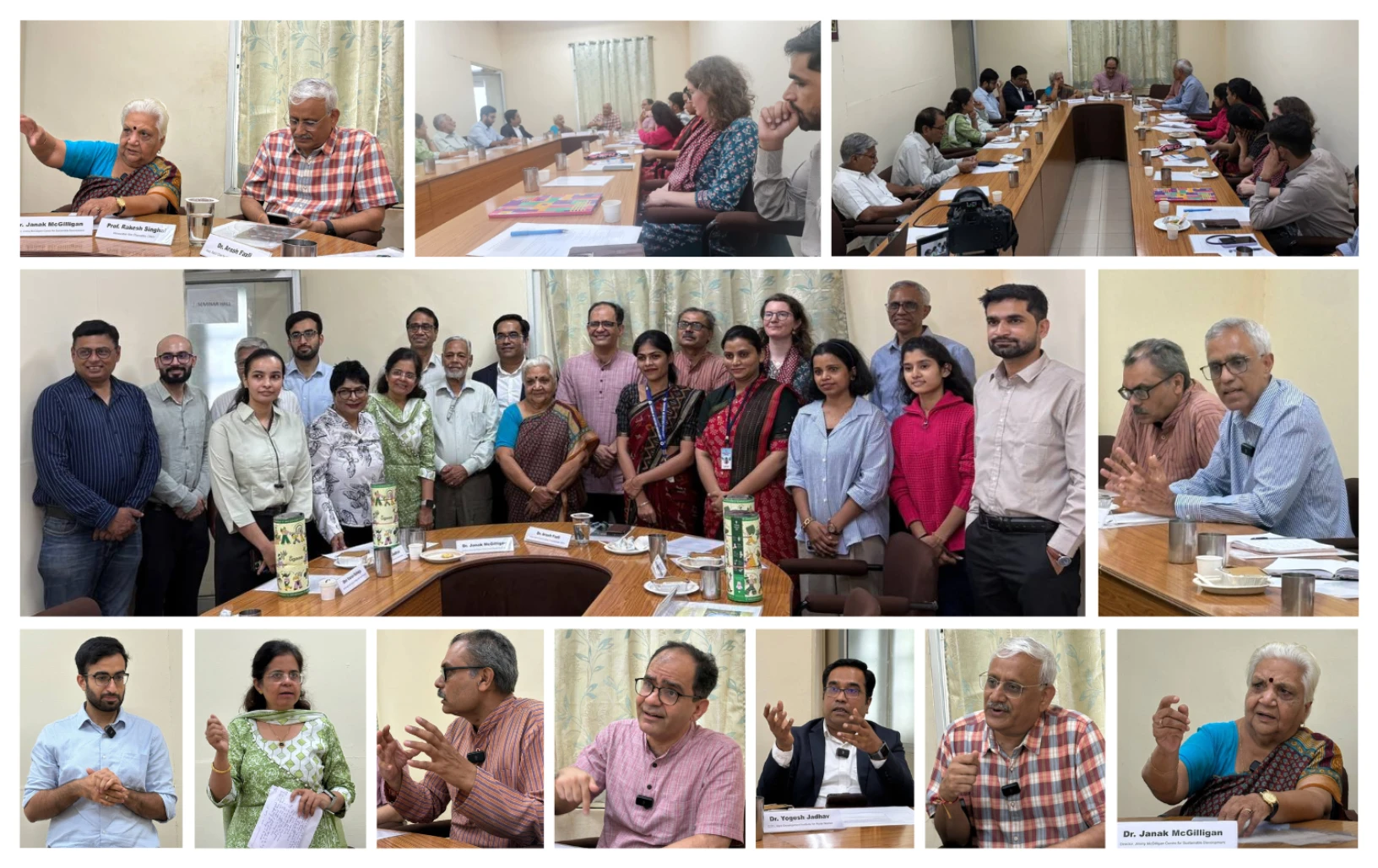

Organized by the Bahá’í Chair for Studies in Development, Devi Ahilya Vishwavidyalaya Indore, 29 September 2025. The Bahá’í Chair for Studies in Development, Devi Ahilya Vishwavidyalaya (DAVV), convened a high-level roundtable today on the theme “Environmental Conservation and Economic Development: Finding the Balance.” The event brought together academics, environmentalists, social entrepreneurs, and students to deliberate on reconciling the urgent need for environmental stewardship with India’s pressing development imperatives.
Opening the session, Dr. Arash Fazli, Head of the Bahá’í Chair, emphasized that the current environmental crisis must be viewed not merely as a technical or policy challenge, but as a profound moral emergency. “Economic development has to be viewed as a means to an end… profit motive was never the basis for organizing society,” he remarked. Dr. Fazli highlighted the need to distinguish between growth and development in economic terms. “Growth or increase in size should not go on indefinitely or it leads to a system breakdown. Beyond a point, we need development which is the realization of potentialities and not just growth.”
Prof. Rakesh Singhai, Hon’ble Vice Chancellor of DAVV, acknowledged the dilemmas at the heart of the issue. While underscoring the importance of ecological protection, he reminded participants of the real-life benefits of infrastructure such as the Narmada dams, which significantly improved livelihoods in Madhya Pradesh and Gujarat. “We are fighting nature for our survival,” he observed, noting the challenge of balancing practical development needs with long-term conservation.The roundtable also featured Padma Shri Dr. Janak Palta McGilligan, Founder-Director of the Jimmy McGilligan Centre for Sustainable Development, who shared her decades of pioneering work in restoring degraded land, training thousands of rural and tribal women, and promoting renewable energy solutions. She recounted how six acres of barren land at the Barli Institute and half an acre at the Jimmy McGilligan Centre were regenerated through sustainable practices. She urged participants to see sustainability as rooted in patience, service, and gratitude, concluding: “The best way to thank God is by empowering people and conserving the environment through our everyday choices.”
Dr. Himanshu Upadhyay (Prestige University) critiqued the popular association of development with malls and large infrastructure. “True development is not skyscrapers but access to clean air, water, and soil,” he said. Stressing the need to integrate communities into decision-making, he argued that traditional and community knowledge must be valued in policymaking because it embodies ecological wisdom.
Mr. Varun Raheja, co-founder of Raheja Solar Food Processing, drew attention to the nutritional crisis masked by the pursuit of higher yields. “In search of quantity, density is ignored. Nutrition is more important,” he noted. He highlighted the growing gap between rich and poor farmers, warning that environmental degradation was deepening this divide. Solar-powered innovations, he said, can empower farmers, reduce waste, and create rural livelihoods, while narrowing inequalities.
Mr. Ambrish Kela, co-founder of Jaivik Setu and MD of Scientech Technologies, emphasized the power of individuals to effect change. He cautioned against seeing technology as a curse, arguing instead for its wise application. “Individual social responsibility is different from corporate social responsibility. Each of us has the power to change the world. Quality of life matters more than unchecked growth,” he asserted.Mr. Yogesh Jadhav, COO of the Barli Development Institute for Rural Women, pointed to the 17th Sustainable Development Goal of “Partnership.” He argued that balance between conservation and development could be achieved through micro-level initiatives in villages and through cumulative grassroots efforts, rather than through greed-driven models.The session concluded with remarks from Mr. Divy Kaushal and Mrs. Umi Saran, who underscored the need for a collective effort that includes all species in the web of life. They stressed that genuine economic development will only emerge when human beings recognize the intrinsic value of nature and act as stewards rather than exploiters.
The event underscored that a new paradigm of development is urgently needed—one that integrates ethics, values, and sustainability into the very fabric of economic planning. As Dr. Fazli concluded: “We cannot find a solution to the environmental problem using cost benefit analysis. We need a fundamentally ethical and value-based approach where we accept that any form of exploitation of nature or degradation of nature is simply not acceptable.”