

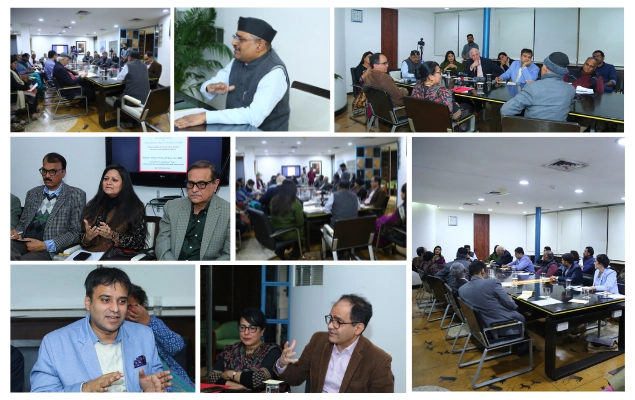

New Delhi, 5 December 2025 — A roundtable discussion on “The Role of Media in Fostering Constructive Public Discourse,” jointly organised by the India Habitat Centre and the Office of Public Affairs of the Bahá’ís of India, brought together senior journalists, media professionals, scholars, and practitioners for a thoughtful exchange on the responsibilities and possibilities of contemporary journalism.
Moderating the session, Prof. (Dr.) K. G. Suresh, Director, India Habitat Centre, expressed hope that the media would regain public trust and, through constructive and inclusive discourse, play a pivotal role in realising the vision of a Viksit Bharat. He emphasised that in an age of rapid technological change and information overload, the responsibility of the media to inform with accuracy, context, and ethical clarity has become more critical than ever.
Speaking on behalf of the Baha’i Office of Public Affairs of India, Dr. Arash Fazli reflected on the essential role of the media in shaping the quality of public discourse. Highlighting that the strength of a democracy can be measured by the nature of its conversations, he underscored the need for journalism that moves beyond sensationalism to foster understanding, unity, and collective reflection on matters of public concern. Constructive public discourse, he noted, enables citizens and institutions alike to engage meaningfully with the social, economic, and moral questions facing society.
Participants discussed the evolving media ecosystem, noting how digital platforms, artificial intelligence, and changing audience habits have transformed news production and consumption. While acknowledging challenges such as misinformation, sensationalism, and commercial pressures, speakers emphasized that credible and context-rich journalism remains both necessary and viable. Several panelists pointed to the continued relevance of print, television, radio, and emerging digital formats, each playing a distinct role in informing, explaining, and humanising public issues.
The roundtable also highlighted the importance of editorial leadership, professional training, and ethical standards in strengthening public confidence in the media. Regional and language journalism was acknowledged for its deep social connect, while young journalists and women professionals shared perspectives on the need for mentorship, institutional support, and safe spaces for responsible reporting. Participants agreed that technology can assist journalism but cannot replace human judgment, ethical responsibility, and a commitment to truth.
The discussion concluded with a shared recognition that the media remains a vital institution for nurturing informed dialogue and social cohesion. Through continued engagement, collaboration, and reflective practice, participants affirmed that journalism can play a constructive role in shaping narratives that contribute to understanding, trust, and the collective well-being of society.