

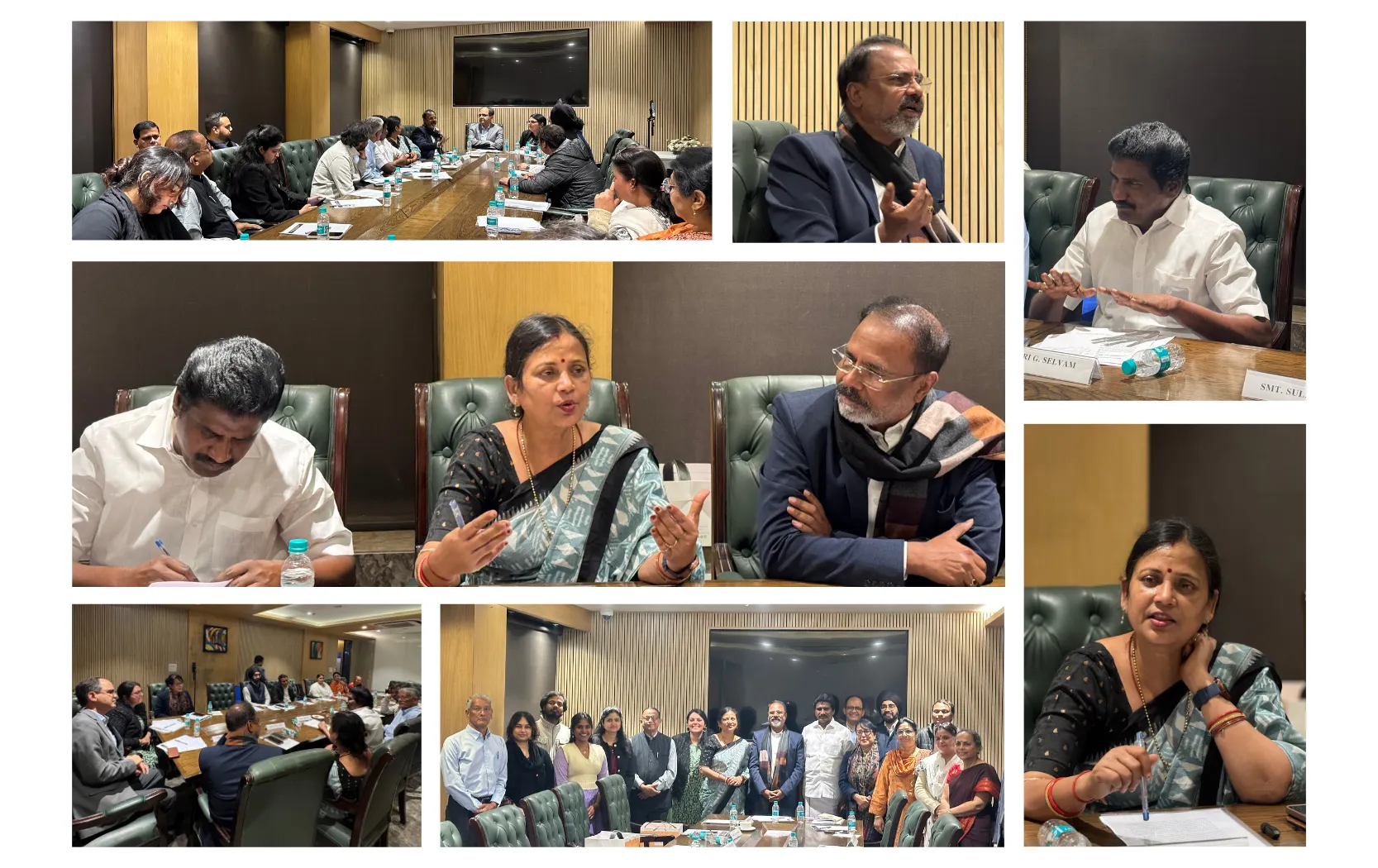

New Delhi, 12 February 2026 — The Office of Public Affairs of the Bahá’ís of India convened a roundtable consultation with Members of Parliament at the Constitution Club of India on the theme “Action for Gender Equality: Begin at Home.” The gathering brought together parliamentarians, friends from civil society, and members of academia to examine how the family can serve as a foundational space for advancing the principle of the equality of women and men.
Over the past two decades, the Office of Public Affairs, in collaboration with numerous individuals and organizations, has sought to advance a national discourse on gender equality. In recent years, a distinct thread of this discourse has focused on the role of men as promoters of the equality of the sexes. These conversations have consistently returned to the family as a fundamental social institution—where conceptions of the roles of women and men are first learned, internalized, and practiced.
In its opening remarks, Mrs. Carmel Tripathi, Director of the Office of Public Affairs, noted that the family is not only the first environment in which patterns of thought and behavior associated with being a man or a woman are acquired, but also the structure in which these ideas are given concrete shape through defined gender roles. A society’s progress toward equality, it was emphasized, will remain superficial unless a parallel effort is made to refashion the family as an institution that increasingly embodies this principle. The consultation therefore sought to initiate a conversation on the changes the family must undergo to become a seedbed for attitudes, values, and practices that promote equality and model the transformation society seeks to achieve.
The roundtable was attended by honorable members of Parliament Shri K. P. Tenneti, Member of Lok Sabha, Smt. Sulata Deo, Member of Rajya Sabha, and Shri G. Selvam, Member of Lok Sabha.
Smt. Sulata Deo spoke candidly about how gender inequality begins within the family and is rooted in deep-seated social attitudes. She reflected on how discrimination between sons and daughters manifests at home—in nutrition, education, emotional support, and expectations—and how societal practices like dowry and the preference for sons continue despite progress. She also drew attention to the weakening of family bonds, lack of mental health awareness, and the pressure placed on children to perform rather than be nurtured according to their individual talents. Emphasizing the need for a change in mentality and value-based upbringing, she said, “There is no difference between daughters and sons,” and reminded everyone, “The foundation should be strong. If the foundation is not right, then a five-story house can never be built on it.”
The address by Shri K. P. Tenneti underscored that gender inequality is sustained not merely by individual acts of violence but by systemic denial of opportunity, particularly access to education and mobility. Drawing on extensive experience in law enforcement and research on human trafficking, the speaker emphasized that vulnerability begins at the source—when girls are out of school and excluded from structures that protect and empower them. Reframing exploited women as “victims” rather than offenders, he called for greater societal and state accountability in addressing structural injustices. The practical example of adopting a village with 100% girl-child dropout and enabling continued education through the provision of bicycles illustrated how even modest, well-targeted interventions can produce transformative outcomes. The overarching message was clear: sustainable gender justice requires creating enabling conditions that expand opportunity, dignity, and agency for girls and women.
Shri G. Selvam reflected on how deeply embedded social attitudes within families contribute to gender inequality. He noted that popular notions—such as the idea that “the mother-in-law is the first enemy of the daughter-in-law”—reinforce harmful stereotypes and reduce women to the role of “a child-bearing machine.” He emphasized that the root cause of inequality lies in the denial of education to girls, which limits their economic independence and excludes them from decision-making within the family. When men become the sole breadwinners, he observed, they tend to hold the “upper hand,” leaving women financially dependent and often silenced—sometimes even facing violence when they raise questions. Stressing the transformative power of learning, he stated, “One of the ways to eradicate this is through education.” He further underscored, “The fundamental issue for this inequality… the main thing is education,” highlighting that equal access to education is essential for restoring dignity, participation, and balance within both the family and society.
Drawing on examples from Tamil Nadu, he highlighted state initiatives that have successfully promoted girls’ education and welfare, demonstrating how sustained public investment can strengthen families and communities alike.
The roundtable reinforced the importance of aligning public policy with social practice. It was noted that lasting progress will depend on integrating legislative measures with cultural transformation, particularly within the family as the nucleus of society. The event concluded with an acknowledgment of the value of sustained dialogue and cooperative effort in advancing gender equality, and with the hope that such consultations will continue to inform both policy and social action in the years ahead.