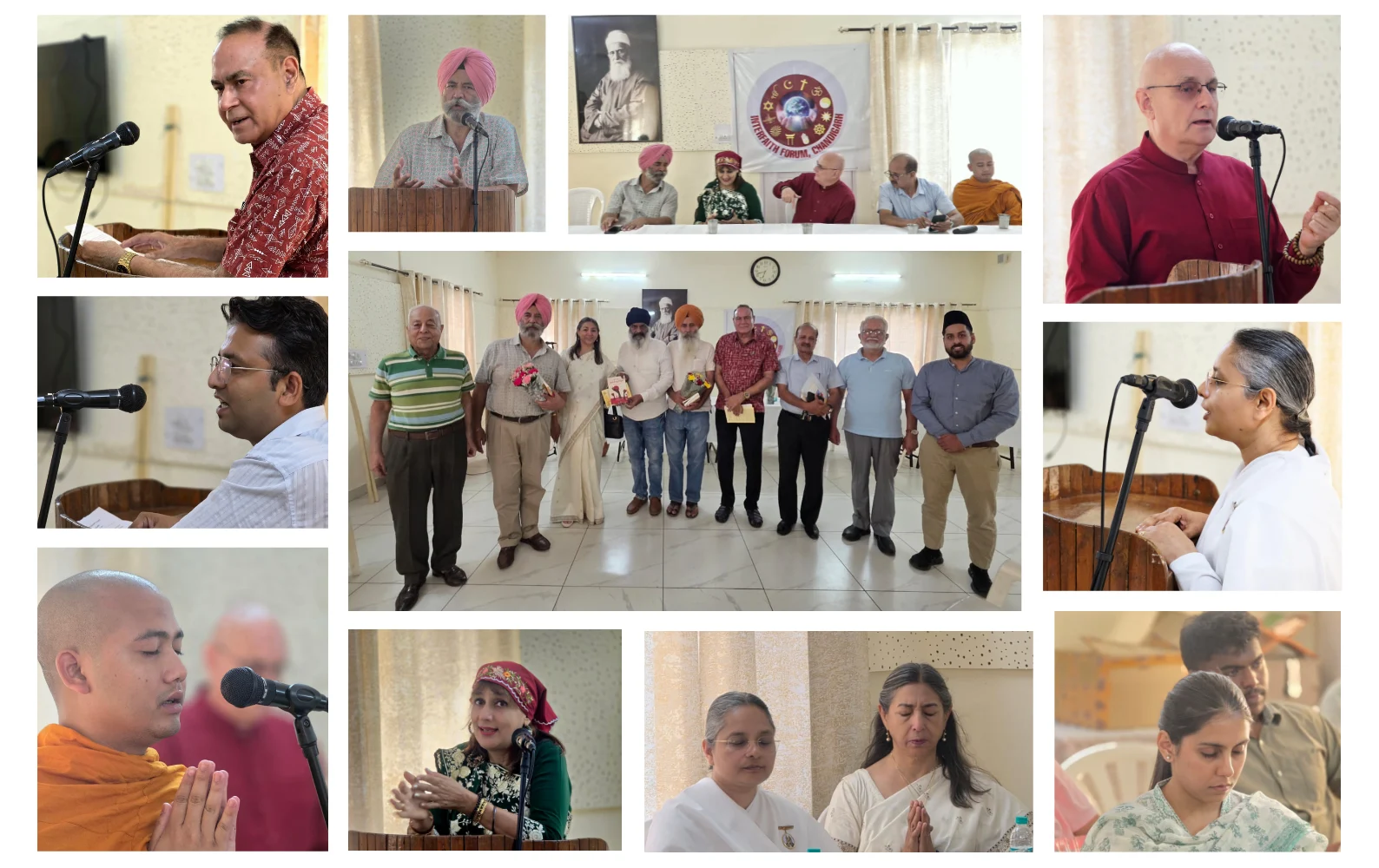

The Interfaith Forum Chandigarh organised a significant gathering to offer prayers for world unity and world peace, bringing together citizens of the city on a common platform rooted in shared spiritual values. The initiative was warmly received across Chandigarh, with many describing it as a timely and much-needed response to the distressing conflicts and divisions witnessed around the world in recent times. Prof. Anil Sarwal, Chairperson of the Forum, moderated the proceedings and stated that the organisation intends to work steadily towards establishing Chandigarh as a “Peace City,” carrying the message of harmony and mutual respect into schools, colleges, and other institutions across the city.
The event drew participation from representatives of a wide spectrum of religious and spiritual traditions. Speaking with one voice, the speakers reflected on the Oneness of God and the common spiritual thread that runs through the world’s different faiths, emphasising that all of humanity ought to be regarded as one family, bound together despite outward differences of belief and practice. Representing Zoroastrianism, Mrs. Nazneen Tiwari spoke on universal peace and the necessity of compassion and love. Speaking on the theme of peace, Brahma Kumari Sister Neha and Lama Yeshe Rabgaye both delivered messages on the centre of inner and world peace. Highlighting the Sikh perspective, Mr. Gurpreet Singh and Kamal Singh Malhi emphasised that there is only one God, whom we should love purely for the sake of God, noting that Sikhism strictly forbids hatred, mandates mutual love, and teaches believers to serve humanity, while also addressing the importance of service, contemporary community dynamics, and individuals embracing the faith in Tamil Nadu. Discussing the Islamic viewpoint, Prof. Mohammed Khalid focused on certain laws and highlighted the foundational importance of prayer, explaining how it helps an individual grow spiritually. Mr. Gopal Kaushik brought forward a profound Bahá’í perspective on universal brotherhood, centering his address on the principle that “the Earth is one country and all mankind its citizens.” Utilising the allegory of three stonecutters to illustrate the need for a elevated collective vision, he traced the historical evolution of human organisation from families and tribes up to the modern nation-state, explaining that humanity is now maturing into a vital stage of global unity. He highlighted how the core spiritual tenets of the world’s major faiths, including the Hindu ethos of Vasudhaiva Kutumbakam, Islamic teachings on understanding diversity, Christian love, Sikh equality through Langar, and Buddhist compassion, all seamlessly converge on the foundational oneness of humanity. Stressing that true unity brings diversity rather than uniformity, Mr. Gopal compared the human family to a single physical body and a vibrant garden, where every unique part is profoundly interdependent and bound by shared vulnerability. He concluded by urging the audience to dissolve the artificial distances between human hearts and actively choose to build global solidarity through wisdom, justice, and love.
Each speaker dwelt on the profound interdependence of human beings, urging individuals to cultivate inclusive and compassionate ways of thinking, to listen with genuine understanding before responding, and to let their actions be guided by kindness, empathy, and selflessness rather than self-interest.
The discussion also turned to the current state of global affairs, with the Forum observing with concern that wars and armed conflicts continue to claim the lives of hundreds of thousands of people. The function drew to a close with solemn prayers offered for peaceful coexistence, loving fellowship among people of all faiths, and a collective message of unity intended to resonate well beyond the boundaries of the city. Organisers expressed hope that the spirit of the gathering would inspire similar efforts elsewhere, reinforcing Chandigarh’s emerging identity as a city committed to the cause of peace.