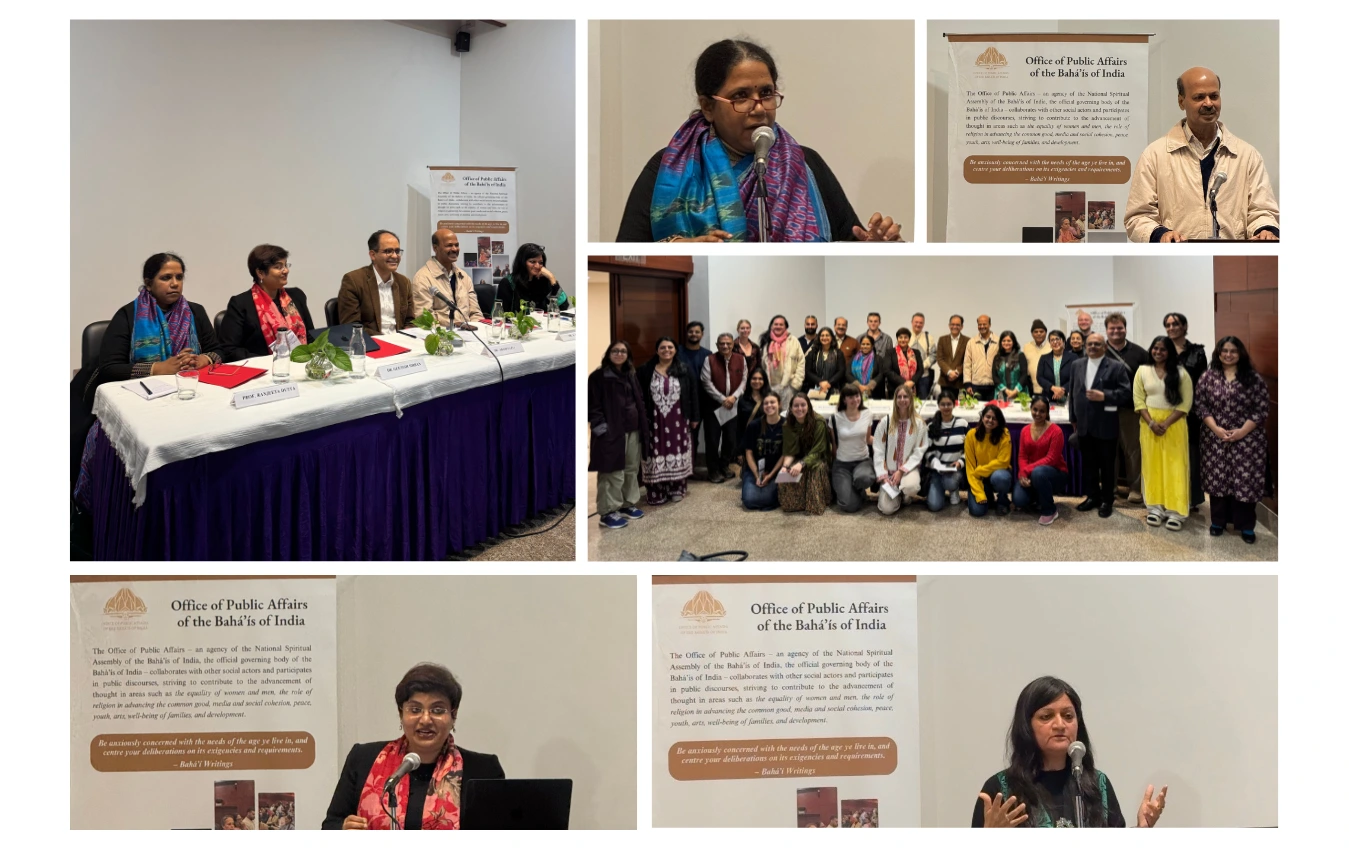

New Delhi, 6 February — The Office of Public Affairs of the Bahá’ís of India convened a symposium titled “Drawing on the Power of Faith in Building a United India” at the Bahá’í House of Worship, bringing together scholars, practitioners, and media voices to explore how religion can serve as a unifying force in contemporary India.
Setting the tone for the discussion, Ms. Nilakshi Rajkhowa, Director of the Office of Public Affairs, shared that for several years the Office has been engaged in conversations with diverse groups on the role of religion in contributing to a just and harmonious society. While religion has historically provided moral guidance and ethical direction, she noted that the present moment also sees it misused as a source of division and conflict. In such a climate, the need to clearly articulate the constructive and unifying purpose of religion becomes especially urgent.
The Chairperson of the session, Dr. Arash Fazli, Head of the Bahá’í Chair for Studies in Development at Devi Ahilya University, Indore, emphasised that religion today is not confined to the private sphere. In India in particular, faith continues to shape public life, social values, and political discourse. The question, he suggested, is not whether religion should influence society, but how it should do so. Rather than allowing its power to be channelled by narrow interests, citizens and institutions must consciously draw upon religion’s ethical core to strengthen unity and social cohesion.
Referring to ideals such as Vasudhaiva Kutumbakam and recalling Mahatma Gandhi’s efforts to harness religious imagination for inclusive nation-building, the discussion highlighted faith’s potential to transcend boundaries, foster compassion, and inspire collective responsibility. Constructive engagement, it was noted, must involve not only religious leaders but also individuals, communities, and institutions such as the media, judiciary, education system, and the state.
The symposium featured Prof. Ranjeeta Dutta, Associate Professor of Medieval and Early Modern History at the Centre for Historical Studies, Jawaharlal Nehru University; Dr. Geetesh Nirban, Associate Professor and Head of the Department of Philosophy at Kamala Nehru College, University of Delhi; Dr. A. Cyril, SJ, Executive Director of the Indian Social Institute; and Ms. Aditi Tandon, Associate Editor and Bureau Chief at The Tribune.
Prof. Dutta encouraged participants to reflect on the religious diversity embedded in everyday urban life. India’s syncretic traditions, she observed, continue to shape lived experiences despite urbanisation and globalisation, demonstrating that integration often grows from shared daily spaces. Emphasising the organic nature of unity, she stated, “When we talk of religious integration, we must also speak of religious diversities. It is through these diversities—and through our everyday experiences of living and moving among them—that the idea of religious integration gradually takes shape.”
Drawing on Indian philosophical traditions, Dr. Geetesh Nirban reflected on concepts such as Vasudhaiva Kutumbakam and Advaita, emphasising the need to turn to India’s intellectual heritage when addressing contemporary challenges. “When we are discussing religion, when we are talking about a united India, and when we are examining the issues arising around religion, it is important for us to look at the concepts that can guide us—concepts that carry deep philosophical significance,” she noted. Acceptance, she explained, goes beyond tolerance; it recognises difference as enriching rather than threatening, grounding unity in a shared consciousness.
From a human rights perspective, Dr. Cyril stressed that faith must remain “anchored” in its ethical core, promoting dignity, service, and mutual care rather than serving political agendas.
Ms. Tandon highlighted India’s democratic fabric, characterised by its multitude of languages, religions, and communities. Despite visible fault lines, she noted, a deep spiritual unity continues to bind the nation, forming a priceless heritage that must be safeguarded.
The symposium concluded with a shared recognition that faith, when consciously directed toward the common good, can strengthen solidarity and help build a united India. Participants underscored that religion’s true power lies not in asserting difference, but in cultivating ethical action, compassion, and a sense of shared destiny.