

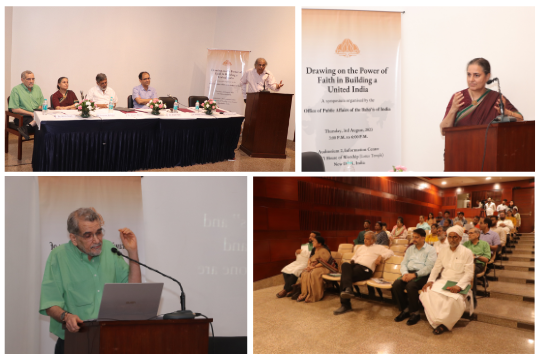

The alarming rise of religious fanaticism, dogmatism and prejudice throughout the world has made it imperative that the unifying and constructive nature of religion be more deeply appreciated and understood. This was the purpose of a symposium organized on 3 August by the Office of Public Affairs of the Bahá’ís of india titled ‘Drawing on the Power of Faith to build a United India’. The event brought together four distinguished Indian social scientists to reflect on the constructive role religious faith plays in the life of the nation and the conditions necessary to perpetuate its wholesome influence on individual and collective life. One of the speakers opined that there is the need to reaffirm the truths that lie at the core of all religions – that all of creation is united by its origins in a spiritual source, that this spiritual source is highest and strongest link of interconnectedness between all human beings and all of creation, and that this sacredness at the heart of creation compels the qualities of humility, love and generosity within us. He observed that this return to spirituality was the greatest antidote to the excessive selfishness, individualism, competition and greed in our world. He further discussed the dire need for applying spiritual principles to development policies that affect the well-being of the masses.
Another speaker observed that faced with the many cases of religion being invoked as a pretext for conflict, it has become important to initiate a discourse to seek out and affirm the first principles that underlie all religions. He identified these principles as a sense of connectedness with other human beings and with nature, empathy and compassion. These principles must serve as a touchstone for all statements and practices claiming to be religious.
A third speaker pondered on the significance of religion as the source of those norms and values that society needs to maintain social and economic order. Without these norms, the trust and goodwill on which all healthy social and economic relations depend, would disintegrate.
The fourth speaker, a retired professor of political science, emphasized that the spiritual principles of religion are inculcated through rituals and practices which in turn serve some social purpose. The challenge is that over time the practices of religion have lost their connection with the spiritual principles and social purpose they were meant to serve. She called for critical dialogue not only to restore this wholeness of religious belief and practice but also to sift out from the corpus of statements and actions that were part of religion those practices which may have been added to religion and which have no contemporary relevance nor any edifying influence.