

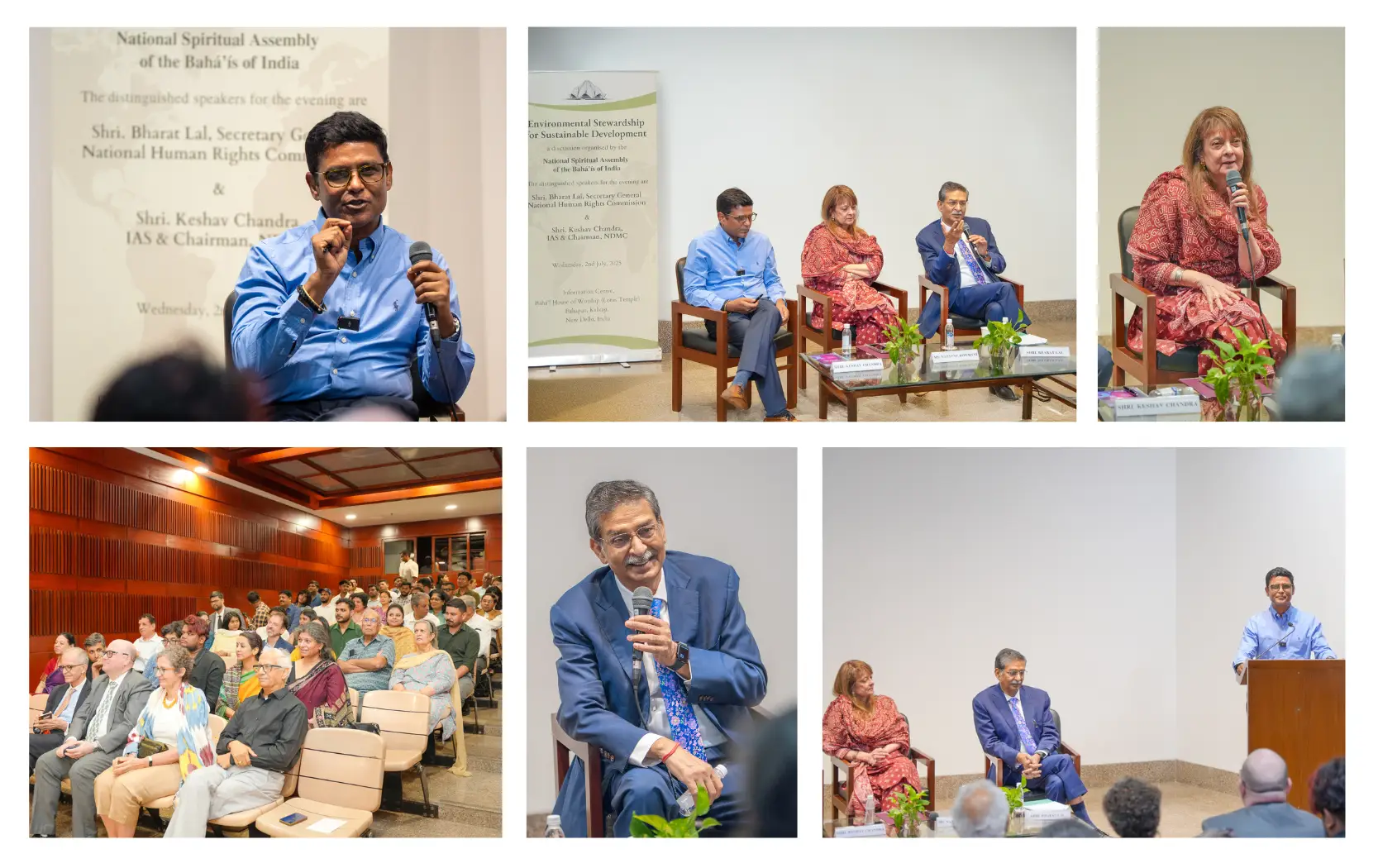

The National Spiritual Assembly of the Bahá’ís of India hosted a thought-provoking discussion on Environmental Stewardship for Sustainable Development on Wednesday, July 2, 2025, at the Information Center of the Bahá’í House of Worship in Bahapur, New Delhi. The event brought together individuals from diverse backgrounds committed to advancing environmental sustainability and collective well-being.
The evening featured two distinguished speakers: Shri Bharat Lal, Secretary General of the National Human Rights Commission, and Shri Keshav Chandra, IAS & Chairman of NDMC. Their addresses offered profound insights into the moral and institutional responsibilities required to safeguard the environment.
Shri Bharat Lal, in his compelling remarks, highlighted the transnational nature of environmental issues, stating, “You have to talk about unity, because climate action cannot stop at borders. We have to work together.” He urged a blending of traditional wisdom and modern governance, saying, “Let us blend the voices of harmony, the Indian tradition of reverence, and the power of modern policy into the future – where environment is not polluted, nature is not destroyed, no one is excluded, development is not destructive, and sustainability is not a slogan but a reality.”
In his remarks, Shri Keshav Chandra emphasized the need for unified effort, stating, “It is the responsibility of every individual to contribute, because it is not just one entity that can deliver all the goods or make life sustainable.” He further shared that water is a collective property and must be treated as such. Speaking about air pollution, he noted that there is no one-size-fits-all solution for all countries; rather, a scientific approach tailored to local realities is essential. He highlighted that addressing these environmental challenges requires raising the collective consciousness of the people.
Ms. Naznene Rowhani, Secretary General of the National Spiritual Assembly of the Bahá’ís of India, also shared her reflections, stating that “In world undertakings, one critical area for such unified action is that of preserving the resources of this planet.” She stressed that addressing environmental challenges requires global solutions built on unity and cooperation. Emphasizing that sustainable development is a holistic process, she noted the importance of tackling systemic inequalities and ensuring fair access to resources and opportunities for all. In her concluding thought, she affirmed that “sustainable development cannot occur without justice.”
The event concluded with an engaging interaction between the speakers and participants, fostering a spirit of collaboration and reinforcing the collective resolve to build a sustainable, inclusive, and just future.