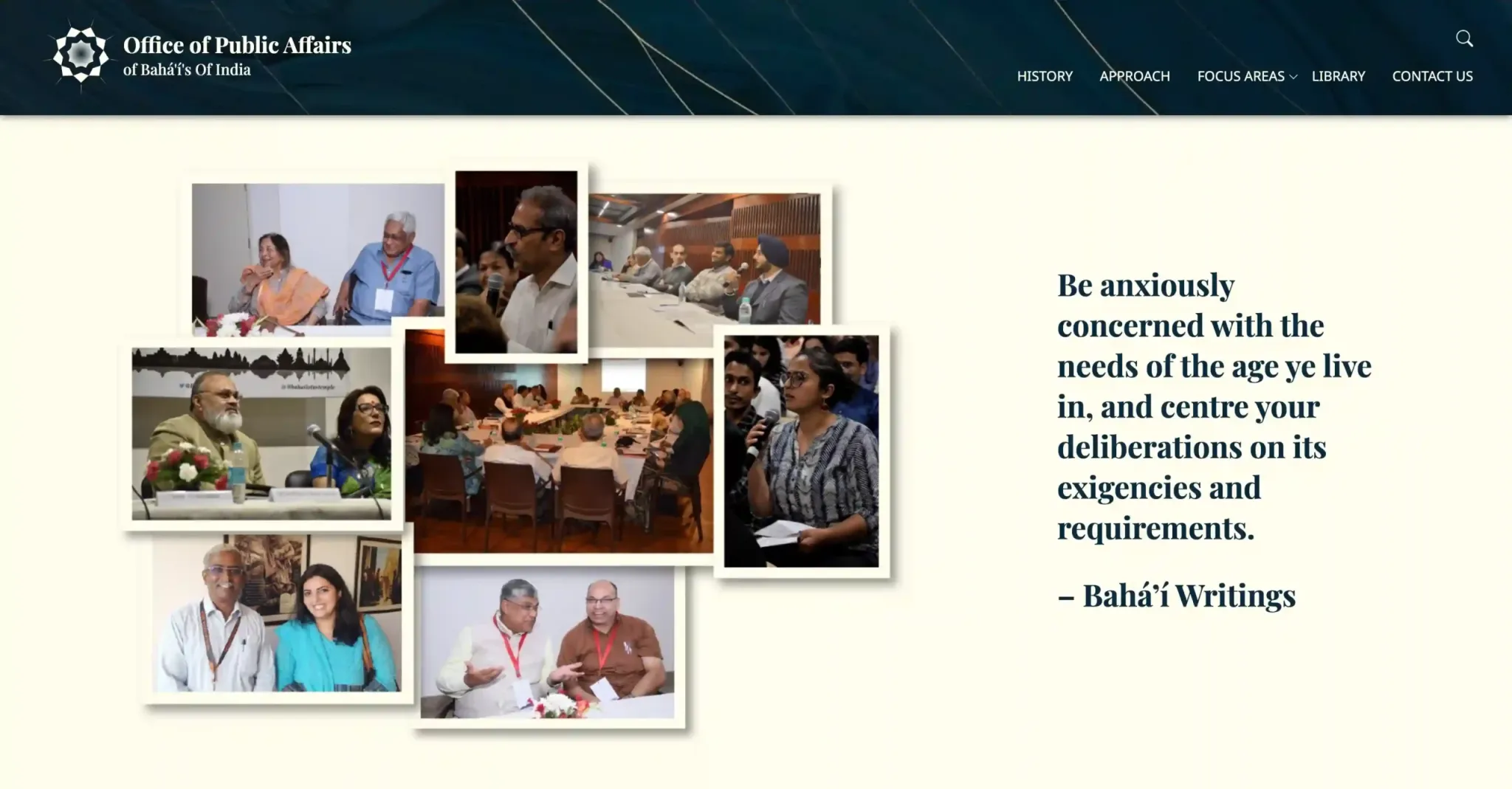


The Baha’i Office of Public Affairs of India in collaboration with the National Commission for Minorities, Government of India hosted an interfaith dialogue on the theme ‘The Divine Educators and the Nature and Purpose of Religion.’ This event was held at the office of the National Commission for Minorities, New Delhi, to celebrate the birth anniversary of the Twin Prophet Founders of the Bahá’í Faith – The Bab and Baha’u’llah.
The gathering was chaired by the Honorable Chairperson of the National Commission for Minorities, Shri Iqbal Singh Lalpura and graced by another member of the Commission Shri Dhanyakumar Jinappa Gunde. The event featured speakers from different faith traditions including, Dr. Arash Fazli, Head of the Bahá’í Chair for Studies in Development, Devi Ahilya Vishwavidyalaya ; Dr. Khwaja Iftikhar Ahmed, Founder President, Interfaith Harmony Foundation of India; Prof. Madhu Khanna, Professor of Indic Religion, Tagore National Fellow, National Museum; Dr. M.D. Thomas, Founder Director, Institute of Harmony and Peace Studies, Rabbi Ezekiel Malekar, Chief Priest, Judah Hyam Synagogue; Prof. Salim Engineer, Vice-President, Jamaat-i-Islami Hind; Dr. Shernaz Cama, Parsi Zoroastrian community representative; Mr. Lokesh Jindal, Tibet House and Sister Husain from Om Shanti Retreat Centre, Gurugram.
In her opening remarks, Ms. Nilakshi Rajkhowa, Director, Baha’i Office of Public Affairs, discussed the theme of crisis and victory that characterized the life of all the Divine Educators including the Bab and Baha’u’llah. She focused attention of the participants on the questions posed in the concept note prepared for this gathering which asked – how can consciousness of the oneness of the Divine Educators and their purpose be recognized and propagated? and how can their message be related to the needs of today’s society?
In their comments, the speakers discussed the need for educating children and youth in universal values, the need for increasing the levels of discourse on the oneness of religion, the need to recognize true Divine Educators as distinguished from those using religion for ulterior motives, and the need to increase inter-religious understanding to overcome prejudices and check hate speech. In his concluding remarks, Shri Lalpura commented on the vital importance of interfaith dialogue of this kind and for faith representatives to take a united stand on addressing contemporary issues facing India. He emphasized the need for organizing more interfaith discourses that highlight how the teachings of religions can address the country’s developmental issues.