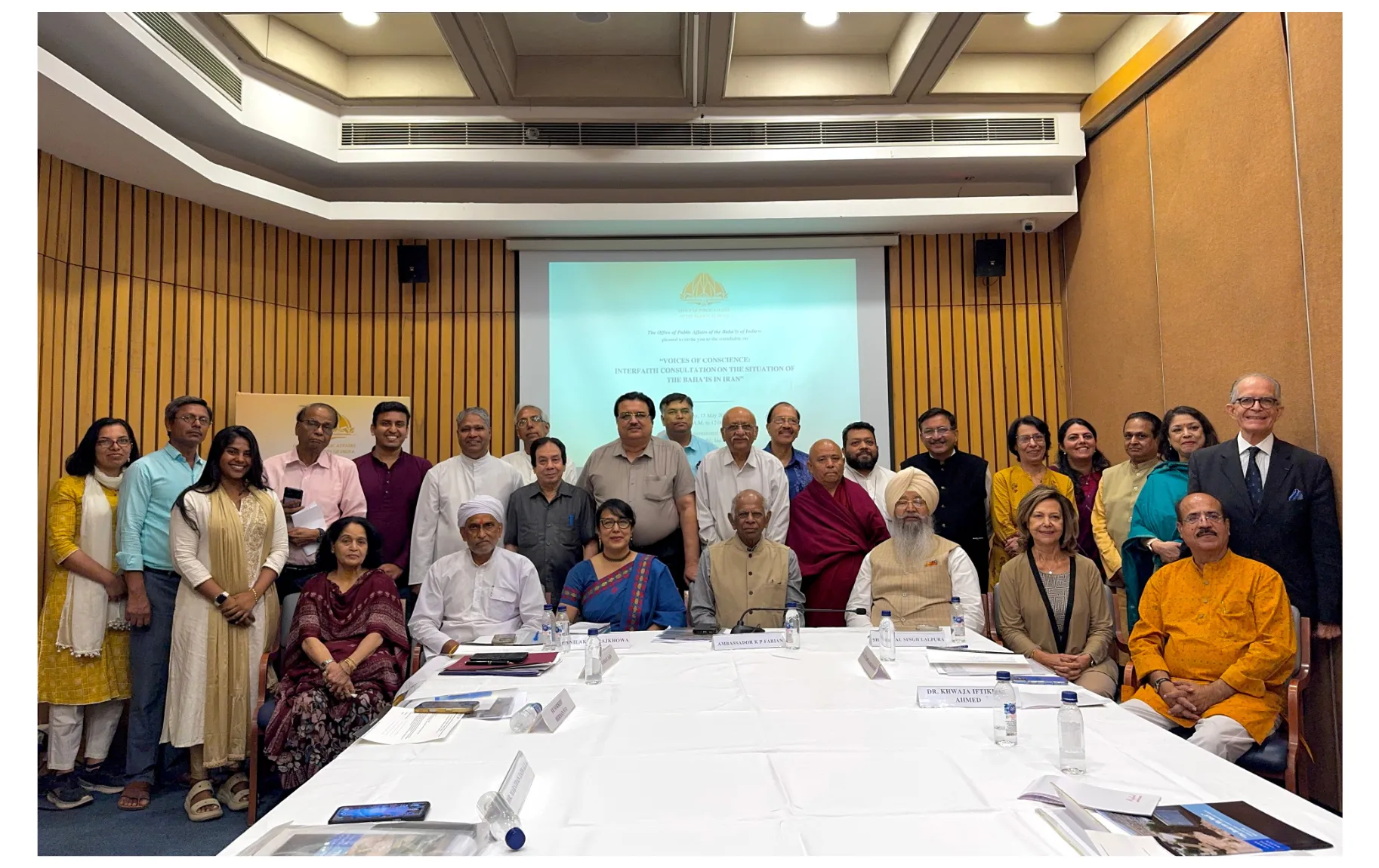

New Delhi, 15 May 2026: Religious leaders, scholars, diplomats, and representatives of diverse faith traditions gathered at the India International Centre, New Delhi, for an interfaith roundtable titled “Voices of Conscience: Interfaith Consultation on the Situation of the Bahá’ís in Iran,” organized by the Office of Public Affairs of the Bahá’ís of India.
In her opening remarks, Mrs. Nilakshi Rajkhowa, Director of the Office of Public Affairs of the Bahá’ís of India, highlighted the longstanding persecution faced by the Bahá’í community in Iran and emphasized the moral responsibility of the international community to uphold human dignity, justice, and freedom of conscience.
Speaking on the significance of the gathering, she said, “Today’s consultation is not merely about the situation of one community or one country. It is about the kind of world we wish to build – a world where freedom of conscience is protected, diversity is embraced as a source of strength, and the suffering of any people becomes a concern for all humanity.”
Delivering the keynote address, Shri Iqbal Singh Lalpura, former Chairperson of the National Commission for Minorities, Government of India, emphasized that the persecution of the Bahá’ís in Iran concerns humanity as a whole and not merely one religious community.
“The issue of the Bahá’ís in Iran is not merely a Bahá’í issue. It is a human issue. It is a question of justice, dignity and universal human rights,” he stated. “The true test of democracy is how secure minorities feel—not only legally, but emotionally and socially,” he remarked.
He further stressed that interfaith dialogue is essential for peacebuilding in the modern world. “When religious leaders sit together, societies become safer. When faith communities cooperate, extremism weakens. When conscience speaks collectively, injustice loses legitimacy.”
The session was chaired by Ambassador K. P. Fabian, Professor at Symbiosis University, Pune, who highlighted that interfaith engagement must move beyond symbolism and contribute to moral awareness and constructive action.
Participants included Dr. Khwaja Iftikhar Ahmed, Founder of the Interfaith Foundation of India; Rabbi Ezekiel Isaac Malekar, Chief Priest of the Judah Hyam Synagogue; Fr. Norbert Herman SVD from the Catholic Archdiocese of Delhi; Mr. Sanjay Jain, Secretary General of AICI; B.K. Sister Hussain from the Brahma Kumaris; Acharya Yeshi Phuntsok representing the Buddhist community; Mr. Waris Husain from Jamaat-e-Islami Hind; Mr. Marazban Zaiwalla from the Zoroastrian community; Reverend Father Akira Isaac and Acharya Satyendra Narayan.
Participants collectively expressed deep concern regarding the continuing persecution faced by the Bahá’ís in Iran, including denial of higher education and employment, confiscation of properties, arbitrary arrests, destruction of cemeteries and holy places, restrictions on livelihoods, and campaigns of hate propaganda.
Several speakers noted that the persecution of the Bahá’ís represents not only a violation of human rights, but also an assault on the principles of coexistence, diversity, and human dignity upheld by all religions.
Throughout the roundtable, participants repeatedly affirmed that the suffering of the Bahá’ís in Iran cannot be viewed in isolation, but must be understood as part of the broader global challenge of protecting freedom of belief and human dignity for all people.
There was also collective appreciation for the constructive resilience demonstrated by the Bahá’í community in Iran over decades of persecution. Speakers observed that despite systematic oppression, Bahá’ís have continued to contribute to society through education, service, community-building, and peaceful coexistence.
Another sentiment that strongly emerged during the consultation was the recognition that silence in the face of persecution only deepens injustice. Participants across faith traditions emphasized that the suffering of the Bahá’ís in Iran should awaken a collective moral response from people of conscience everywhere. Many speakers reflected that defending the rights and dignity of religious minorities is not merely an act of solidarity with one community, but a defense of the spiritual and ethical foundations of society itself. There was a shared feeling that diversity is a source of strength for humanity and that societies flourish when all communities are able to contribute freely and live without fear. Several participants also noted that interfaith unity and sustained dialogue are essential in countering prejudice, extremism, and dehumanization in today’s world.
At the conclusion of the consultation, a resolution was passed unanimously by the participants. The resolution will be shared with the concerned authorities and relevant institutions as an expression of collective solidarity and called for justice for the Bahá’ís in Iran, the protection of freedom of belief, and safeguarding of the inherent dignity and human rights of every individual.