

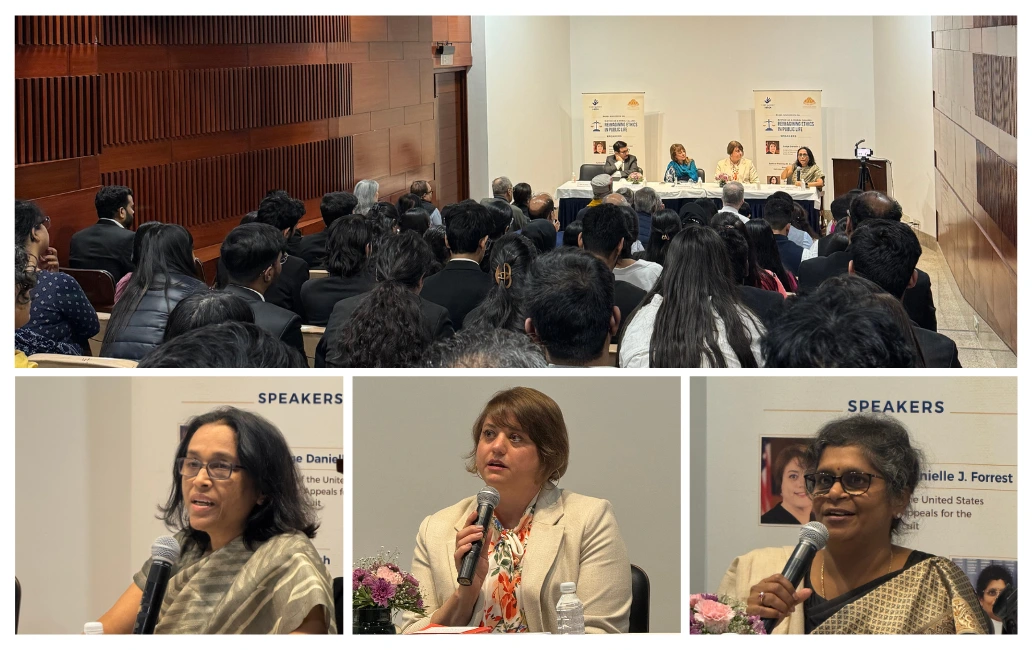

November 18, 2025: In a reverent atmosphere at the Baha’i House of Worship (Lotus Temple), New Delhi, judicial and academic leaders convened on Tuesday evening to explore the moral foundations of justice and the ethical responsibilities of public institutions. The panel discussion, “Justice as a Moral Calling: Reimagining Ethics in Public Life,” was jointly organised by the Office of Public Affairs of the Bahá’ís of India and Human Rights Defense International.
Opening the panel, the Ms. Naznene Rowhani, Secretary General of the National Spiritual Assembly of the Bahá’ís of India framed justice as inseparable from moral character, stating: “Justice cannot be disassociated from moral integrity. Our moral compass shapes how we understand truth, how we treat those who differ from us, and how we respond in moments of conflict. Justice also requires a commitment to the common good, especially at a time when societies face prejudice, inequality, political strife, and environmental degradation.”
The evening’s first speaker was Judge Danielle J. Forrest of the United States Court of Appeals for the Ninth Circuit, who was visiting India for the 26th International Conference of Chief Justices of the World organised by City Montessori School Society. Reflecting on her experiences, she noted “Realizing that law is a human endeavour… There is a human being at the end of every case… And I think that that’s one way that we can rededicate the idea of justice”, emphasising the human dimensions that underlie judicial processes.
Justice Prathiba M. Singh of the Delhi High Court followed with a perceptive reflection on ethics in public office, particularly in the context of emerging technologies. Speaking on the limitations of artificial intelligence in judicial work, she stated: “AI can assist, but it cannot replace human compassion, empathy and emotional quotient… Justice dispensation is not mechanical. It is definitely not, you know, automated. And it requires a lot of empathy. It requires compassion. And it requires a human’s humane approach.”
The programme concluded with Prof. Geeta Gandhi Kingdon, Professor at University College London and Manager of the City Montessori School Society, who highlighted education’s role in cultivating moral consciousness. She remarked: “Justice is a universal thing and it must touch all our lives in whatever field of endeavour we may be associated with.. Schools have emphasis on character education. It’s not only a place where academic education and knowledge is increased and skills are developed, but it’s also a place where character is developed..” Her comments drew a connection between personal development and societal progress.
The audience’s participation added further depth to these deliberations, with students, legal practitioners, and civil society members posing questions on judicial challenges, institutional ethics, and the moral responsibilities of citizens. The event served as a reminder that justice is not merely a legal construct but a profoundly moral endeavour—requiring clarity, compassion, and a steadfast commitment to the common good.