
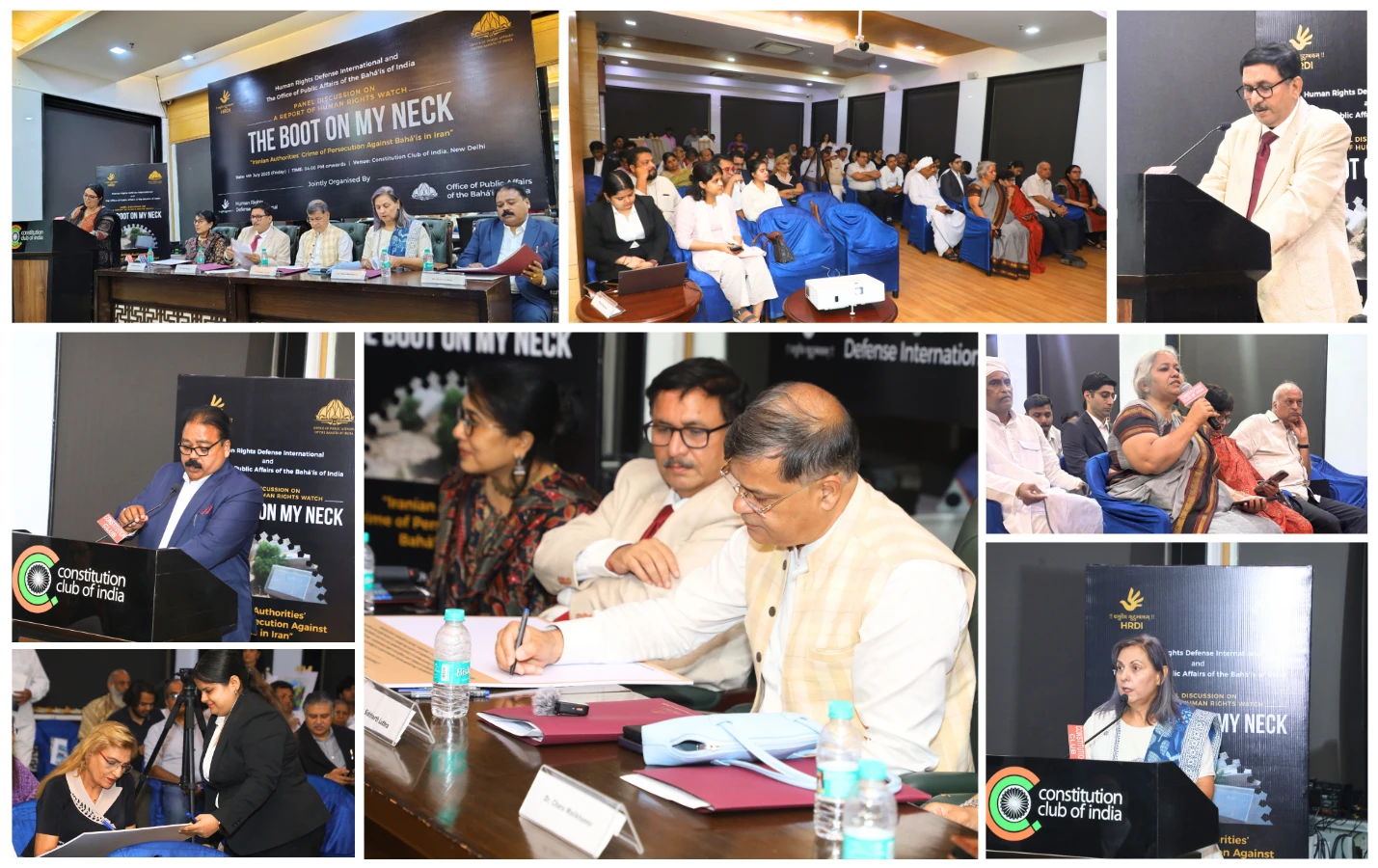

On 4th July 2025, human rights advocates, academics, authors, media and legal professionals gathered at the Constitution Club of India, New Delhi to reflect on the Human Rights Watch report “The Boot on my Neck” which highlights Iranian authorities crime of persecution against the Baha’is in Iran. This event was jointly organised by the Human Rights Defence International (HRDI) and the Office of Public Affairs of the Bahá’ís of India.
Mr Rajesh Gogna, Secretary General of Human Rights Defense International in his welcome address shared, “the right to freedom of religion or belief is enshrined in the Universal Declaration of Human Rights, and Iran is a signatory to the International Covenant on Civil and Political Rights. And yet, for the Bahá’ís, these international guarantees remain letters on a page — silenced by the boots of tyranny and theological authoritarianism.” This was followed by introductory remarks by Ms. Nilakshi Rajkhowa, Director of the Office of Public Affairs of the Bahá’ís of India, who outlined the objectives of the gathering and the importance of international solidarity in the face of state-sponsored persecution.
Among the speakers, Dr. Sidharth Luthra, Senior Advocate, Supreme Court of India and former Additional Solicitor General, highlighted the systemic oppression faced by religious minorities, in his words “Iran is a case in point where the administration of the constitution shows that the beauty of the language of rights is often lost by oppressive legislation which restricts the very rights…when you fail to recognize a minority as an individual community, what are you doing? You are becoming worse than what we call othering. Othering is when we start distinguishing in society as us and them. But when you actually choose not to identify or acknowledge them, that really takes them out of the margins of the rights that are guaranteed under law or under the constitution which makes them perhaps less than human. And that’s a question you need to talk about”
Dr. Charu WaliKhanna, author and former member of the National Commission for Women, spoke passionately about the intersectional challenges faced by Bahá’í women, including arbitrary detention, physical and mental assault, and state-backed coercion to renounce their faith. She gave examples of women who faced disproportionate punishment and even chose martyrdom over forced conversion, underscoring the deep gendered and religious oppression they endured and concluded with the words “Iran has ratified the CRC, Child Rights Convention, CCPR, Civil and Political Rights Convention and also the rights of persons with disability, but where are we now? Is it enough? Is ratification enough? Or should states be held liable for dehumanizing human beings?….. we all should build up a movement to build international pressure against the state of Iran so that the world can be a peaceful place.”
Dr. Anthony Raju, Advocate, Supreme Court of India and Chairman of the All India Council of Human Rights, emphasized the universality of human rights. He drew attention to Iran’s violation of rights enshrined in international covenants and Indian constitutional values, calling on civil society to become vocal allies for the persecuted: “This is not just about Iran. This is about the global responsibility we all share to protect freedom of belief. A declaration that no matter where a crime against humanity arises, the conscience of the world will respond”
The program concluded with formally reading out the Delhi Declaration, a collective statement condemning the persecution of Bahá’ís in Iran. It was signed by panelists, special guests, and attendees, symbolizing a united stand against religious intolerance.