
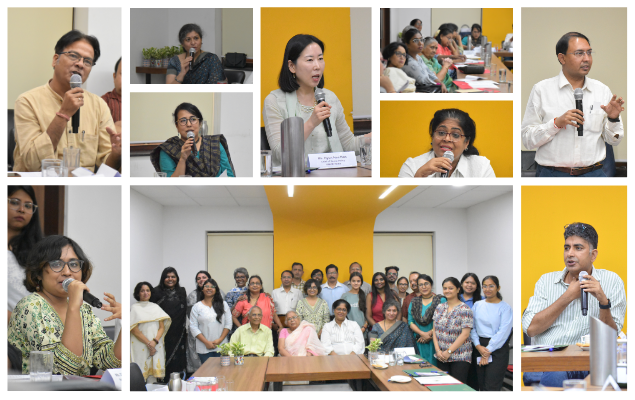

On the occasion of World Environment Day, the Office of Public Affairs of the Baha’is of India along with the Young Women’s Christian Association (YWCA) India and the India Alliance for Child Rights (IACR) organized a symposium on 7 June, 2024 on the theme ‘Children, Youth and Climate Change: Realities and Lessons Learned’. The symposium aimed to bring into focus the concerns and issues related to children and youth in the discourse on climate change. A concept note prepared for this symposium noted that the event sought to not only bring to the fore the dangers facing this age group by the climate crisis but also to emphasize the need to give a voice to the young in decision making and policy making on this vital issue. As the document noted, “rather than treating children and youth paternalistically by considering them lacking in maturity or understanding, a spirit of adult behaviour must be shown to them where their capacities to understand profound issues, contribute their perspective on serious issues and take responsibility for addressing issues as a member of society is recognized and fostered.”
This event was the first in a series of discussions that the Office plans to organize on children, youth and climate change in collaboration with YWCA and IACR. In her remarks at the beginning of the session, Ms. Nilakshi Rajkhowa, Director of the Bahá’í Office of Public Affairs, mentioned that the idea for organizing these series of events came up as a result of the common concern among the three collaborating organizations to advance the discourse on the well-being of children in society.
The keynote speaker for the symposium Ms. Hyun Hee Ban, Chief of Social Policy, UNICEF India shared the global picture from the 28th United Nations Climate Change Conference or COP28, where one of the main agendas was to urge world leaders to ensure that children and youth are at the core of global climate policies. She also shared about how UNICEF is embedding the lens of climate change in the various lines of work they are engaged in such as health, nutrition, education, water and sanitation, child protection and social protection. She emphasized that the participation of children in major decisions that have an impact on their lives must be considered an imperative.
During the discussion, one panelist highlighted the importance of justice in developing strategies to mitigate climate crisis since the crisis affects different groups and segments of the population differently. Another panelist spoke of the need for viewing children and youth as stakeholders in decision making about development projects and of developing a sense of solidarity with them. The need to view youth and children as active agents of change and fostering intergenerational dialogue that bridges the experience of policy makers with the lived experiences of children and youths was emphasized by the third speaker. Building on this, the fourth panelist focused on the need for creating consultative spaces that are open and receptive to young people by imbuing them with trust in one another, love, compassion and finding commonality in religious scriptures.